
Employment Relations Amendment Act 2026 - Employer Update
Effective from 21 February 2026, this Act introduces five key changes. Not all will apply to every organisation, but it’s worth checking where you sit and what to do.
Removal of the 30-day rule (for Collective Agreements only)
New employees are no longer required to be employed on collective agreement terms for their first 30 days.
What to do:
Review and update offer documentation.
Ensure payroll and HR processes reflect the change.
Get your HR and payroll people up-to-speed.
Are they a Contractor or Employee - the Gateway Test
A new test is introduced with easily understood criteria to confirm when a worker is a contractor or an employee.
How it works
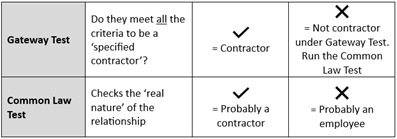
The Gateway Test
The test requires all 5 criteria to be met:
A written agreement specifying that they are a contractor, not an employee;
The worker is not restricted from working for others, except while actually performing work for the principal;
The worker is not required to work certain days/times or is able to sub-contract;
Arrangement may not be terminated if the worker declines work;
Reasonable opportunity for independent advice before signing.
This change cannot be applied retrospectively to current contractors
The Common Law Test
Intention
Control v independence
Integration
Fundamental / economic reality
What to do
Review your contractor agreements.
For current contractors, if you want the certainty of them meeting the Gateway Test, negotiate a variation to their agreement. You can only do this with their agreement. If agreement not possible, apply the Common Law Test.
For new contractors, the Gateway Test applies provided your contractor agreement meets the requirements.
High-income threshold for personal grievances
Employees earning over $200,000 per year (total remuneration) cannot bring a personal grievance related to their dismissal.
What applies when
For new employees – applies immediately
For existing employees – will be the default position in 12 months time.
In both situations, employers and employees can agree in writing to retain the (previous) dismissal protections.
Regardless of which option applies, expect to negotiate.
What is total remuneration?
Total remuneration = salary + benefits
What is / is not included will be determined by case law over time. The current potential list includes salary, overtime, bonuses, commission, share incentive schemes and vehicles.
A risk we see is that employees hit the $200k mark and employers (and employees) are caught by surprise.
What to do
Calculate and record total remuneration in writing and ensure employee is aware.
Agree pay increases in writing. Ensure these are clear to all parties.
Review your IEA templates – update your dispute resolution process.
Consider your approach and the bigger picture before taking action.
Employee conduct in grievance outcomes
The Employment Relations Authority or Employment Court must now consider employee conduct when determining remedies. How this plays out will be determined by case law over time.
Procedural errors
Minor procedural mistakes alone will not automatically make a dismissal unjustified, if the overall decision was fair and reasonable.
Tip - you still need to follow process, be reasonable and act in good faith. We wouldn’t suggest being a test case.
Need a hand?
If you are thinking:
How do I get my head around what is needed for my organisation?
I need a hand with planning and implementing these changes
The RYHR team are here to help.